Lawson Kilpatrick
student
Page & Screen 1103-23
student
Lawson Kilpatrick
Doctor Lucas
Page and Screen (Eng-1103-23)
7 September 2022
“story of my life” Literacy Narrative
I believe my life truly began in the fifth grade, for this is when I found my true love. This love is no living being, no physical object.However, a sport, none other than the sport of Track and Field. My journey into this love of mine began with a man by the name of Willie Parker, better known as Coach Parker. Coach Parker is a decorated Track athlete, having accomplishments ranging from competing on the Division 1 college level to becoming a Coach who would send countless athletes onto college. My first encounter with him was during weight lifting back in middle school, fifth grade to be exact. He was feared amongst us students, his intensity and sense of discipline were dreaded by all. I remember turning around to see him appear in front of me from thin air. “Do you have a brother, Alex? He said. I began to utter out, “yes sir.” He would then look at me and nod, finally saying, “great, see you at the Track after school” as he walked away. I would go through my school day pondering, “what just happened?” Nonetheless, I was aware I had no choice in the matter and would see him again after school.

As my career in Track and Field began, I would be thrown into long distances. The 800m, 1600m, and 3200m were my events. However, I despised these events with every ounce of hatred coursing through my veins. I had renounced running, in my eyes, it was borderline torture. Yet for some reason, I would continue. As time flew by, race by race, I could see myself becoming more athletic, and more applicable to compete with the upperclassman. Before I knew it, my time competing in the long distance was behind me. It would be the end of my sixth grade year when I would be introduced to a variety of new events. Long jump, high jump, hurdles, pole vault, I began to dabble with every event there was. At the time, I did not know why I was being placed in these events, yet I was grateful, for I was no longer running long distances. I would compete throughout the season, placing horrendously amongst the other competitors. However race by race, jump by jump, I began to excel. Soon enough I was introduced to something new entirely, the Pentathlon. The Pentathlon involves five events, the 100-meter hurdles, the long jump, the shot put, the high jump, and finally the 1500 meter. This combined event was something new entirely, a full day’s length long, in the summer heat, competing at the national level. I would compete in the pentathlon throughout the rest of middle school, yet I never found myself truly succeeding. It would be later on in life, my ninth-grade year to be exact, where I would finally find myself flourishing. In the summer of my ninth-grade year, I would compete at the National Championships. Never in my life, had I experienced such fear, such excitement, I haven’t a clue what I was truly feeling. Despite that, I would proceed, one event after the other. Before I knew it, I had become an All-American, placing third in the nation.
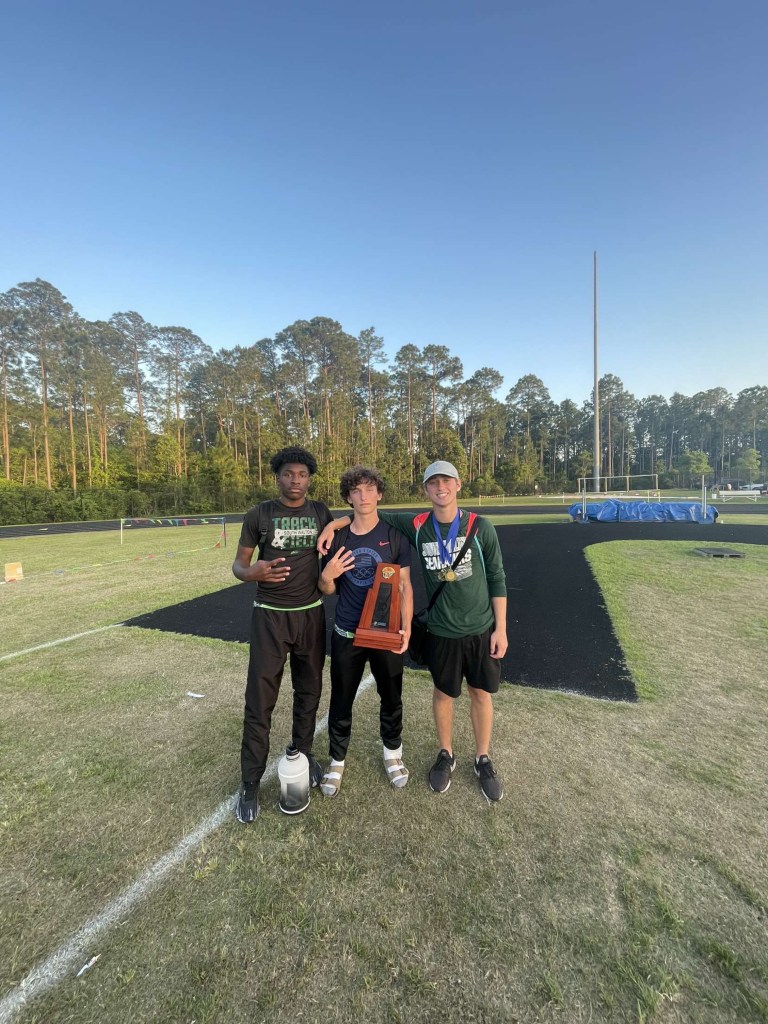
Following my national meet, I would have high hopes for what’s to come. At that, those hopes began to flourish in the following season. Personal best, after personal best, I began to be caught up in the glory of it all. Continuing within track and field, I would enter my sophomore year. Not even considering the troubles and hardships that were in store. I would eventually tear a muscle in my shoulder, requiring immediate surgery. This would require me to move my life to Gulf Breeze Florida, where I would enter physical therapy. An entirely new schedule was placed in front of my eyes. Wake up, complete physical therapy, workout, log on to online school, on a repeated cycle, for the following four months. This entirely was not a serious predicament, however, the problem was that I was living alone. In a place hours from home, not knowing a single soul, this began to take its toll on my mental stability. Day in and day out, strictly following my schedule, and having no other life outside this, I found myself desperate for change. I would have done anything to get out of there, however, there was one person who kept me sane, who kept me hoping for a future that I have always dreamt of, nobody other than Coach Parker. He would begin to call me regularly, reminding me of my dream, and keeping me updated on my teammates at home. One call after the other, day by day, never forgetting, until it was time to pack up and head home healed, ready to compete again. I am not sure if he was aware of the amount of help he was providing, but for him I truly owe him everything. He kept me sane, happy, and determined, never asking anything in return except my dedication to the sport. Looking back at this moment in my life, I now realize how important this event was in my life. It was my first time facing true adversity, living alone, having the feeling my dream was slipping past my fingertips, and yet still being pushed forward.

Jack Rynning, Harry Hennessy, Lawson Kilpatrick, Eric Garguillo
Doctor Lucas
ENG 1103.23
15 September, 2022
Final Essay: Social Media and Its Influence

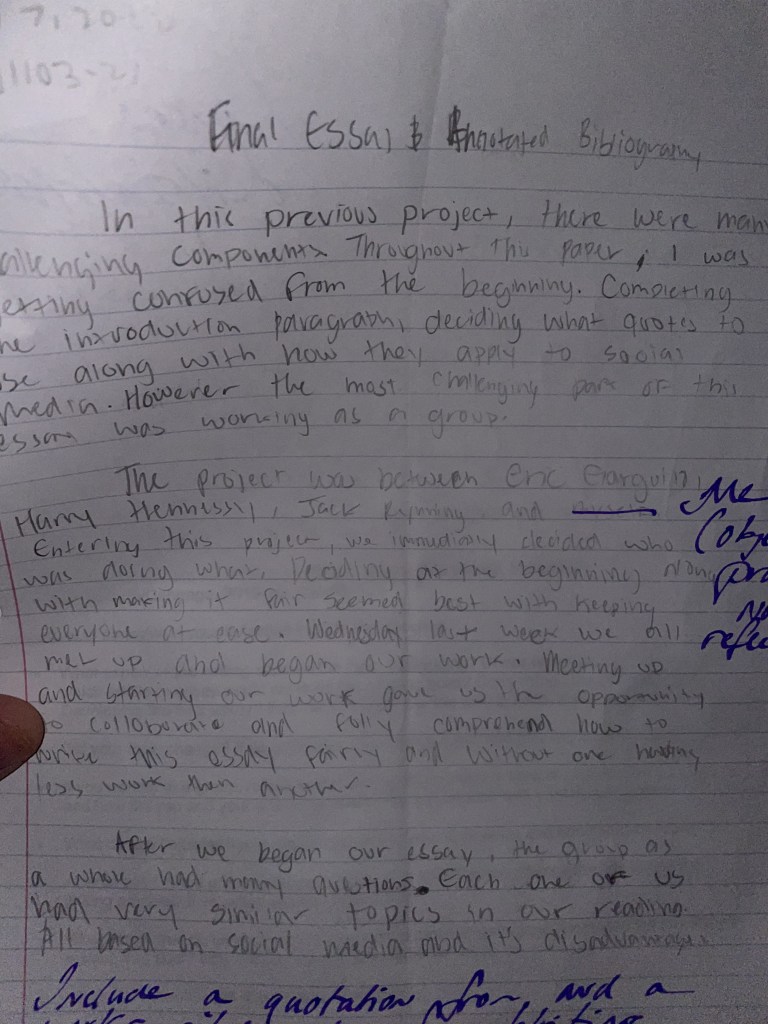
Social Media is a plague that has captured this world. Social Media has honestly become a part of most peoples day to day lives. Wake up, check phone, is a fair amount of people’s first action for the day. Primarily the youth. The youth of this world only know social media, it has always been a part of their lives. Tik tok, Snapchat, Instagram. However all of these media platforms instill a consistent addiction that has some unwanting effects. These effects can be described as promoting an addictive personality, mental disorders, and more. Algorithms and business models also have a large role in one’s social media usage. Another concern with social media is those participating. Nobody has a say as to what others post, therefore there have been a number of scenarios where people have committed crimes and posted them for the world to see. There has even been multiple cases, in which acts of terrorism have taken place.
We composed this essay because we think that social media can have many different effects on many different people. We tried to explore the bad parts about social media and see how it uses its prominence to influence its users. A main reason for researching the effects of social media was to see if other large companies and tech giants used their algorithms to promote radical groups and messages. In “Consequences” by Max Fisher, Fisher tells the reader about how Facebook uses their algorithm to promote radical and terrorist groups and this makes their messages spread very easily which causes extreme events. Other social media platforms do the same thing as Facebook to promote bad things daily. It has become one of the biggest problems on all platforms. These posts can also harm people mentally. Seeing these radical groups and extreme events can cause people to become paranoid and upset. Social media giants should work their hardest to try and eliminate all of these posts from radical groups and they should work harder to try and fix their algorithm that somehow promotes these posts. Social media can be a very dangerous place for anyone who has it. These social media giants make a great deal of money by promoting these certain posts so we can’t see them stopping this anytime soon. Hopefully somebody is able to help take these posts down and stop them from being advertised.
A project that may emerge from our bibliography might be a movement against social media since it affects so many of us on a daily basis. These movements could be in the form of a protest to shine light on how harmful social media is. Not many of us realize how harmful social media is to us, it can mess with the chemicals in your brain and your emotions. Social Media has been known to play a vast role in mental stability. It has an addictive trait, especially to those of young ages, which can later lead to serious mental disorders. With that in mind, this project would primarily fall under psychology. Psychology has a plenty to do with the brain and how it functions, dealing with what causes specific reactions. The use of social media and the impact it has on a person’s brain could be an experiment for a psychologist.
“Families, Not the Government, Should Regulate Big Tech” Summary by Harry Henessey
In the article “Families, Not the Government, Should Regulate Big Tech” written by Kerry Mcdonald discusses how algorithms and business models used by social media companies keep us addicted and may contribute to mental health problems. Mcdonald first introduced the Netflix documentary The Social Dilemma with former social media executives and programmers with inside knowledge on how big tech companies don’t directly care about the next generations well being. It is explained how social media is correlated to the increase rate in anxiety and depression among teenagers and younger. The article also brings up the Capitol riot most recently and opens the idea that “Youtube” and “Facebook” could be a reason for the attacks. The government took action suspending accounts of politicians and public figures who they deemed bad. Kerry follows by arguing that people are capable enough to regulate who they listen to, stating “We can protect ourselves, and our children, by better understanding how social media influences us”. Lastly she illustrates “What we can do as individuals and families” to combat the negative effects it is currently doing to our younger generations. Government regulations will not do us justice and it is our responsibility to be educated ourselves. The five main points presented include “understanding the algorithms”, “be discerning”, “explore alternatives”, “set guidelines and limits”, and finally “prioritize in-person interactions” which can be summarized by saying how to use social media with caution, knowing about its potential symptoms. Social media shouldn’t be someone’s life and society should encourage face to face communication.
The author of the article Kerry Mcdonald, has also written “Unschooled: Raising Curious, Well-Educated Children Outside the Conventional Classroom.” She is a Senior Education Fellow at FEE and host of the weekly LiberatED. Foundation for Economic Education (FEE) is an Atlanta-based libertarian think tank. Kerry’s research focuses on homeschooling and schooling alternatives, self-directed learning, education entrepreneurship, parent empowerment, school choice, and family.
Harry’s Source: McDonald, Kerry. “Families, Not the Government, Should Regulate Big Tech.” Gale Opposing Viewpoints Online Collection, Gale, 2022. Gale In Context: Opposing Viewpoints, link.gale.com/apps/doc/ORTWUY478348441/OVIC?u=hpu_main&sid=bookmark-OVIC&xid=c2b36f36. Accessed 3 Nov. 2022. Originally published as “Families, Not the Government, Should Regulate Big Tech,” Foundation for Economic Education, 15 Jan. 2021.
“Consequences” Summary by Jack Rynning
“Consequences” by Max Fisher is about Facebook and how their platform can be influenced by different radical groups. Fisher has done very much research on this topic and he’s found that Facebook promotes certain posts from radical groups. Other people are starting to catch on to Facebook’s algorithm and see that they use it to promote terrorist posts. Fisher writes “the United Nations had formally accused Facebook of allowing its technology to help provoke one of the worst genocides since World War II”. All of Fisher’s studies started when a worker inside of Facebook noticed the surplus of posts from radical groups and they kept gaining traction. Fisher saw that wars, strange and extreme events kept getting linked back to social media. Fisher found that a group called QAnon, which was identified as a terrorist group by the FBI, were being recommended to a large number of readers as if it was a club, and these recommendations grew this group into a small political party.
Max Fisher is an international reporter and columnist for the New York Times. He has reported from five continents on conflict, diplomacy, social change and other topics. He writes The Interpreter, a column exploring the ideas and context behind major world events. Fisher also launched several web-based projects aimed at expanding the audience for foreign news.
Hooked on virtual social life. Problematic social media use and associations with mental distress and addictive disorders Summary by Lawson Kilpatrick
Vincent Henzel and Anders Håkansson’s article on Social media suggest that social media is a mental deterrent, causing real life problems world wide.With the development of technology, Social Media has swarmed the globe, addicting all those who meet its touch. To the youth of the world, technology is almost everything, playing a critical role in their lives. But is this a good thing? Research studies suggest that social media plays a significant role in addictive behaviors and mental disorders. In the article, Hooked on virtual social life. Problematic social media use and associations with mental distress and addictive disorders, written by Vincent Henzel and Anders Håkansson, the text states, “A cross-sectional self-reported online survey design was utilized, targeting the general Swedish population. The questionnaire assessed a spectrum of behavioral addictions, of which problematic use of social media was the main outcome variable. In the present analyses, problematic social media use was treated as the outcome variable, testing it against a number of factors suggested in the literature to be associated with this behavior.” Henzel and Håakansson use this example to exemplify the reality behind this subject. The questionnaire results suggest that social media has been associated with one’s mental status, specifically the youth. Children between the ages of 12 and 15 are introduced to peer pressure, soon having the desire to fit and not be left out. This fear of not fitting in, soon drives them to be a part of social media. Being a part of social media gives one the ability to keep in touch with others, however soon enough it becomes an addiction.
Vincent Henzel was a professor at Lund University, specifically, in the department of psychiatry. Vincent Henzel, located in Lund Sweden, is now a medical doctor in Stockholm, Sweden. Vincent Henzel has two publications, one being on the effects of social media, along with an article about gambling. The other author, Anders P Håakanson, is now a professor at EpiHealth: Epidemiology for Health, in association with Lund University. Anders Håakanson is a manager in his field of work, along with being a team Manager of a research team.
Source: Henzel, Vincent, and Anders Håkansson. “Hooked on virtual social life. Problematic social media use and associations with mental distress and addictive disorders.” PLoS ONE, vol. 16, no. 4, 8 Apr. 2021, p. e0248406. Gale In Context: Opposing Viewpoints, link.gale.com/apps/doc/A657819738/OVIC?u=hpu_main&sid=bookmark-OVIC&xid=e731c882. Accessed 3 Nov. 2022.
Summary on Social Media Censorship Violates the First Amendment by Eric Garguilo
In this article the topic addressed is in regards to the relationship between Big Government and Big Tech. As described in the article this close relationship between Big Government and Big Tech is allowing them to violate our first amendment rights as American citizens. Author, Bill Hagerty, did an excellent job portraying this idea in the article Social Media Censorship Violates the First Amendment. For example, in this article the text states, “it recently became clear that social-media platforms wrongly banned and suppressed information regarding the origins of COVID-19.” From the article it was clear that the government was trying to hide information regarding COVID-19 and not being able to keep their story straight when it came to mask mandates. The main idea of this article was to shed light on the moves the government is making to slowly take away our first amendment right.
Bill Hagerty is an incredible writer who works for Gale Cengage Learning. Hagerty has four published articles talking about topics such as the queen and topics relating to the new world. Bill Hagerty’s most recent writing is the article, Social Media Censorship Violates the First Amendment. However, Bill Hagerty has been posting articles from dates going back to 1995. Such as the article The scooper poopers, which was released on December 9, 1995.
Hagerty, Bill. “Social Media Censorship Violates the First Amendment.” Gale Opposing Viewpoints Online Collection, Gale, 2022. Gale In Context: Opposing Viewpoints, link.gale.com/apps/doc/GNHDGF058810098/OVIC?u=hpu_main&sid=bookmark-OVIC&xid=4346d75f. Accessed 3 Nov. 2022. Originally published as “Americans, Not Government, Are the Arbiters of Truth,” National Review, 29 July 2021.
Work Cited
Fisher, Max. Prologue: “Consequences.” The Chaos Machine. Little, Brown. 2022.
McDonald, Kerry. “Families, Not the Government, Should Regulate Big Tech.” Gale Opposing Viewpoints Online Collection, Gale, 2022. Gale In Context: Opposing Viewpoints, link.gale.com/apps/doc/ORTWUY478348441/OVIC?u=hpu_main&sid=bookmark-OVIC&xid=c2b36f36. Accessed 3 Nov. 2022. Originally published as “Families, Not the Government, Should Regulate Big Tech,” Foundation for Economic Education, 15 Jan. 2021.
Hagerty, Bill. “Social Media Censorship Violates the First Amendment.” Gale Opposing Viewpoints Online Collection, Gale, 2022. Gale In Context: Opposing Viewpoints, link.gale.com/apps/doc/GNHDGF058810098/OVIC?u=hpu_main&sid=bookmark-OVIC&xid=4346d75f. Accessed 3 Nov. 2022. Originally published as “Americans, Not Government, Are the Arbiters of Truth,” National Review, 29 July 2021.
Source: Henzel, Vincent, and Anders Håkansson. “Hooked on virtual social life. Problematic social media use and associations with mental distress and addictive disorders.” PLoS ONE, vol. 16, no. 4, 8 Apr. 2021, p. e0248406. Gale In Context: Opposing Viewpoints, link.gale.com/apps/doc/A657819738/OVIC?u=hpu_main&sid=bookmark-OVIC&xid=e731c882. Accessed 3 Nov. 2022
Lawson Kilpatrick
Dr. Lucas
Eng 1103-23
16 November 2022
Final Reflection
While enrolled in Page and Screen, my writing skills have begun to improve noticeably. Day by day, essay after essay, I could feel myself becoming more clear and more alluring. Instructed by Doctor Jane Lucas, the Page and Screen class revolves around developing oneself as a writer. Doctor Lucas’s class insists on completing essays, testing one’s ability to express one’s opinion in a clear and informative manner. Along with completing a variety of assignments that inform the reader about topics such as plagiarism and how to fact-check. However, there are specific attributes of this class, which I believe have had the largest impact on me as a writer. To begin, this semester we were assigned with a final essay and annotated bibliography, this alone helped teach us how to properly collaborate. Some other attributes would be the completion of the Check, Please! Assignments, writing longhand, and playing scrabble weekly.
To begin, Doctor Lucas assigned the class a final essay and annotated bibliography. This annotated bibliography required that we work in groups, my group resulting with four people, including myself. The annotated bibliography assignment stated that we must complete a summary of an article of our choice. For this assignment, I read an article about social media and its negative influences. This assignment insisted that we each compile a summary of the article read, along with a group essay, entirely based on what we read. This assignment helped instill a sense of group work, allowing us to better understand how to properly collaborate on an assignment.
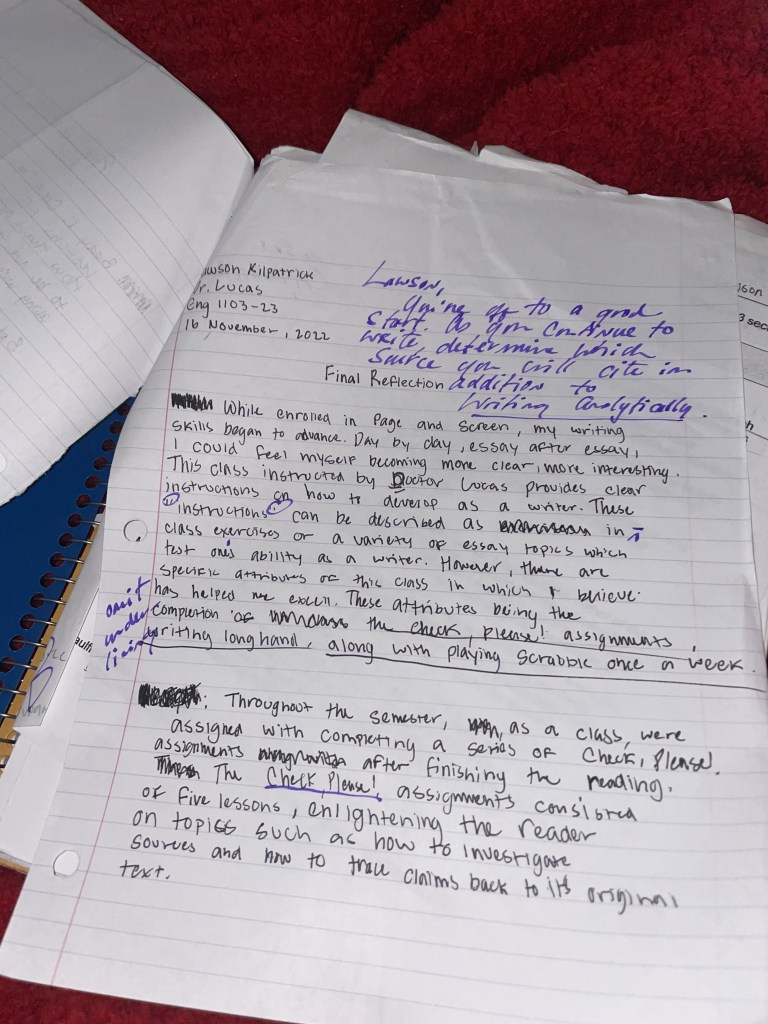
Although there are countless amounts of information that I have been taught this year, I would say, learning how to fact-check plagiarism and false advertisements have been the most useful. We as a class have been informed on such topics through a series of article assignments labeled Check, Please! These assignments consisted of five lessons, enlightening the reader on topics such as how to investigate sources and how to trace claims back to their original text. These lessons help provide insight into how to determine fake news. An example of how to determine this would be listed in Lesson 5: Trace Claims, Quotes, and Media to Their Original Context, where the text states, “ Fortunately, there is a solution to this problem. Usually, the original reporting, research, or photo is available on the web. By going to the original reporting or research source (or finding a high-quality secondary source that did the hard work of verification) you can get a story that is more complete or a more accurate research finding.” This elaborates on ways to counteract bias and untruthful content. Learning how to check and question is essential throughout one’s daily life, meaning that these acts occur everywhere. Doctor Lucas, including this assignment, gave us the ability to determine truth from lies.
This semester, Doctor Lucas has insisted that we write longhand for class assignments, excluding final drafts. There are many reasons behind her reasoning, such as improving memory along with recall and analysis boost. There has been a worldwide debate for some time, revolving around the idea that handwriting is more beneficial. Writing Analytically has a piece relating to handwriting and its benefits, primarily comparing it to typing. Writing Analytically, written by David Rosenwasser and Jill Stephen, the text stated, “If you are ready to start doing full-fledged drafts, as opposed to various kinds of freewriting, brainstorming, and idea collecting, you might be ready to work from a keyboard and see the results on a screen. But at earlier stages in the writing process, and also, perhaps, in trying to work through a difficult revision, taking pen to paper might be the better tactic.” This here dictates Rosewasser and Stephen’s opinions on writing, describing typing used during the final product, yet handwriting should be used during situations such as freewriting, brainstorming, or idea collecting.
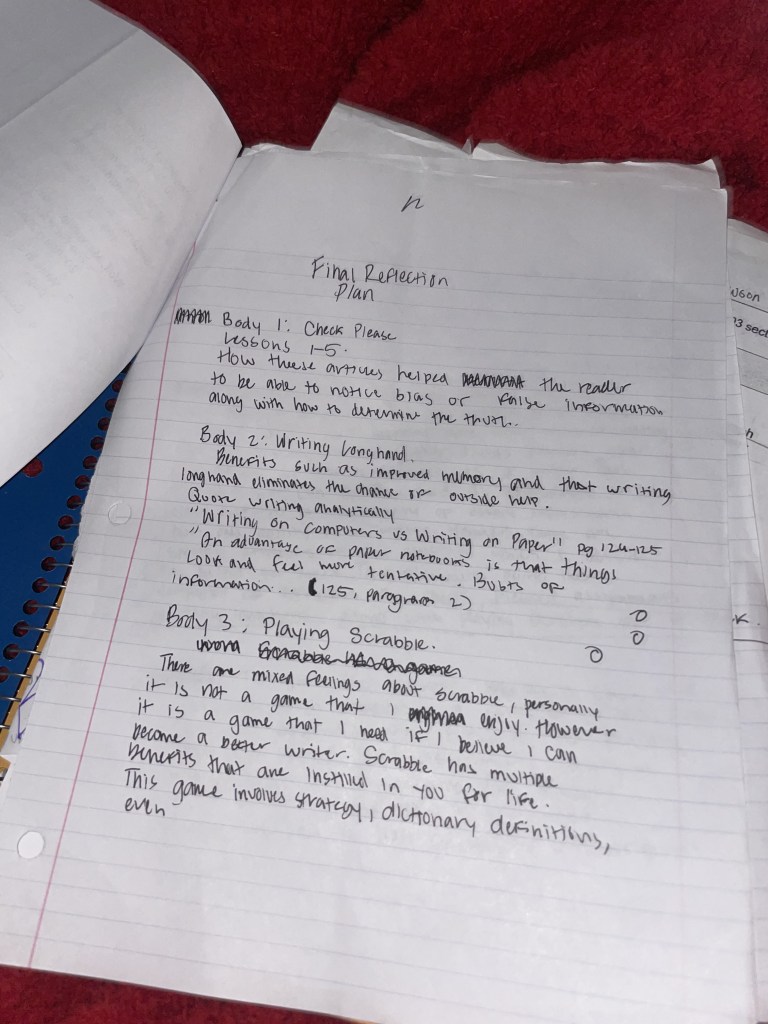
In addition, Doctor Lucas has insisted that we, as a class, play scrabble every Friday. Upon hearing that, most are very confused. However, Scrabble is a game of wits, requiring oneself to be aware of a vast majority of vocabulary terms, along with the skill to play specific words. Playing scrabble has engrained a large variety of vocabulary terms, helping me widen my range of diction. Along with that, Scrabble has helped improve my ability to think on the spot, and to carefully determine where to place certain letters/words for the most points. Not only does this help us improve ourselves in class, but this excites the students, making us look forward to class.
Doctor Lucas’ class, Page and Screen, has instilled a new sense of writing among us students. Throughout this year, we have learned various ways to improve our writing, along with different ways to evaluate a paper. Doctor Lucas has provided an ample amount of assignments including group work such as the final essay and annotated bibliography. Assignments as such, go one step farther than what she has to teach us, helping us get prepared for life after class.Not only has reading and working on other people’s work been of assistance but learning how to detect false information has been crucial throughout this year. Along with playing Scrabble, these attributes have helped me improve, time and time again.
Work Cited
Kilpatrick 1
Lawson Kilpatrick
Dr. Lucas Eng 1103-23
07 October 2022
Scrabble, A Fun Game or Hard work?

Upon reading, Scrabble is a Lousy Game, by Johnathon Kay, I cannot help but agree. Scrabble is a game of wit, having primarily vastly intelligent participants. The essence of this game revolves around an immense knowledge of dictionary terms and the recognition of how to play these words to score the most amount of points. One point of view that Kay mentioned is this game is more work than fun. Kay described how this game is one of memory, a game requiring one to study to succeed. Although, it is the luck of the draw when it comes to obtaining the letters, playing against someone with a higher intelligence almost always ends in defeat. Yet, there are many cases where cheating does take place. This would have to be the third reason behind my beliefs. Cheating is a common occurrence in this game, it’s known to happen quite often. Since this game revolves around pulling letters out of a bag, one can take a peek inside the bag. Jonathan Kay mentions how he believes scrabble resembles a math test. Kay proceeds to compare playing this game to reciting pi, however not knowing that it expresses the ratio of a circle’s circumference to its diameter. I believe this is an excellent analogy about one playing a word, yet not knowing the definition of said word, or where it originates. Another reference Kay made was how he and his friend, John Chew, went out to teach a class of elementary students in hopes of teaching them the art of scrabble. The text states, “One of his handouts listed the four dozen-odd words that contain Q but not U, such as qi. This was a total turnoff. Memorizing lists isn’t fun. It’s work”. It is obvious how Kay feels about this game, that this game is not fun, but undesirable work. In my limited experience playing scrabble, I have been able to play, and in certain scenarios, succeed. However, there have been multiple instances, in which, I haven’t a clue what the word truly means. Keep in mind, the other participants are in the same boat, but what if I were to play someone truly experienced with this game? Someone with an extensive understanding of vocabulary terms? This would more than likely end in utter defeat. Studying can be the deciding factor between a win and a loss. However, many players do not always know what the words mean. What I mean by this is that one can place a word down without knowing its definition or where the word originated. An example of this would have to be when, Kay mentions, “In 2015, the New Zealand Scrabble legend Nigel Richards got so bored by demolishing opponents in English that he memorized a French Diary and won the French-language Scrabble Championships”. This is proof, the evidence behind this theory, that scrabble is an intelligence based game. Cheating occurs in a vast amount of classic video games, I mean who likes to lose?

However, the way scrabble is set up makes cheating very easy and taunting. In the game, one has to start by pulling seven small wooden letters out of a bag. These letters will determine the word you can play for the following round. This is where things get complicated, upon pulling a letter out of the bag, one can glance inside, initially enhancing their ability to play a word in mind. An excellent example of this would have to be Jonathan Kay’s experience behind the Canadian National Scrabble Championships. In the eighth paragraph, Kay states, “Last year, Allen Simmons, a former British champion, was banned from competition after he was caught peeking at tiles before drawing at tiles before drawing them from the bag”. This exemplifies how cheating is very Kilpatrick 4 common in this game, even from the best. Jonathan Kay then stated, “An insider once told me an unsettling story of a contestant who tried to score an illegal word by taking advantage of his opponent’s difficulty in accessing the computer used to determine which words are admissible”. As seen, it is clear that cheating is apparent in the game of scrabble, whether it be with the scorecard or the letters themselves. Scrabble is a lousy game. Simple as that, there is no other game that requires such studying. Jonathan Kay expresses his opinion of this game beautifully. The only way to succeed in this game is to dedicate oneself to studying vocabulary. Kay believes that scrabble is not a game, yet hard work. Following this Kay would provide examples referring to professional players getting caught cheating and even his own experiences playing the game. It is clear, Jonathan Kay intensely disliked this game, and frankly, I completely agree. Can you say otherwise?
Work Cited
Kay, Jonathan. “Scrabble is a Lousy Game.” The Wall Street Journal, 4 Oct. 2018.ProQuest, https://libproxy.highpoint.edu/login?url=https://.proquest.vom/newspapers/scrabble-is-lousy-gamewhy-would-anyone-play/docview/2116081655/se-2?accountid=11411
 Lawson's Word Press